Here's a pattern showing up in classrooms everywhere. A student submits flawless homework. Every answer complete, every essay polished, every problem worked through. Then the exam arrives. Same topic, same concepts. The result? A crash.
The gap can be brutal: homework hero, exam zero.
Stanford's 2026 research tracked exactly this. Students who relied on raw AI chatbots for assignments scored up to 24% worse on proctored exams than peers who used no AI at all. [1] The culprit wasn't lack of intelligence. It was "metacognitive laziness"—a dulling of the very skills that let you monitor your own understanding, catch your own confusion, and wrestle through the hard parts.
The AI didn't cheat for them. It thought for them. And their brains noticed.
"Wait, isn't AI supposed to help?"
Absolutely. But "help" comes in two radically different flavors. One trains you to receive. The other trains you to think. Most families haven't learned to tell them apart.
.
Watch the Difference in Real Time
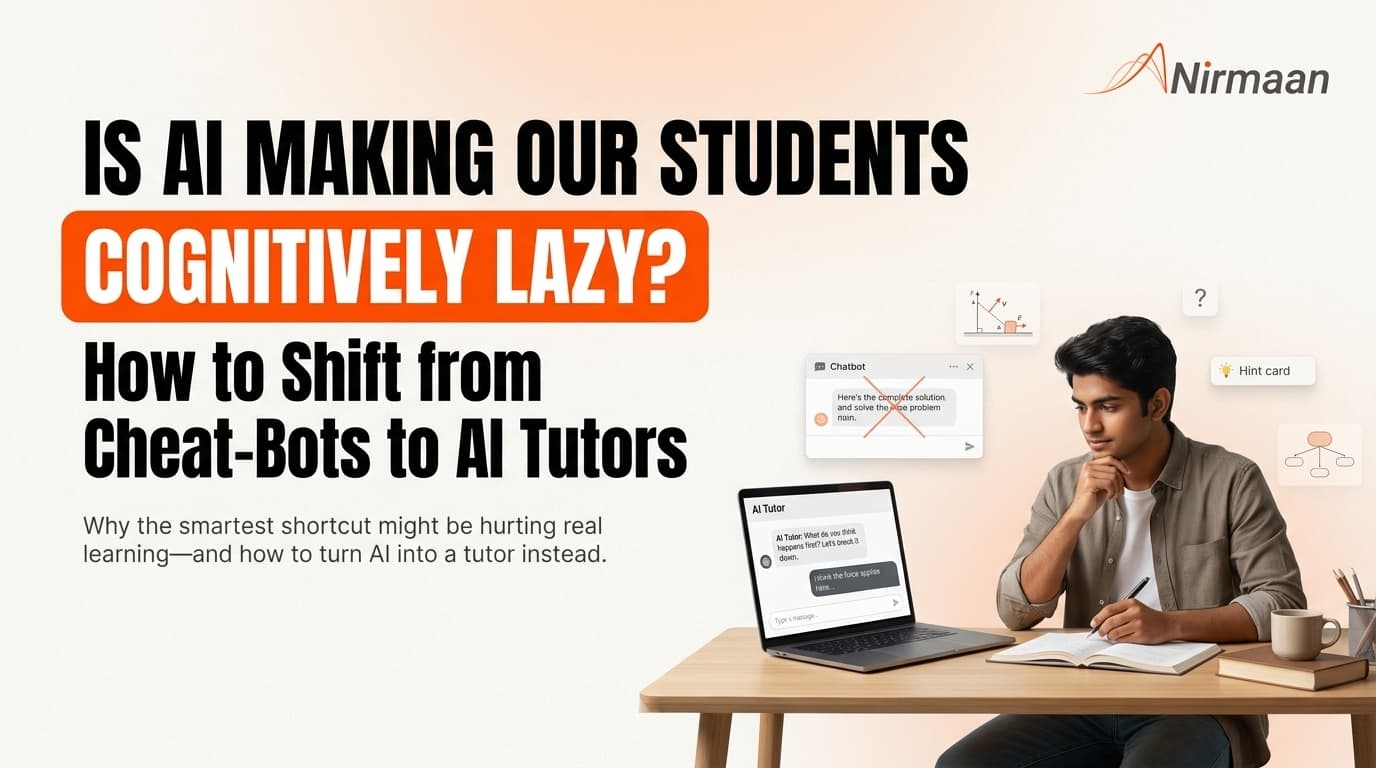
Same student. Same physics problem about inclined planes. Two different tools. See which conversation builds a mind.
Scenario A: The Cheat-Bot
Student: "how do i solve this inclined plane problem with 30 degree angle and 5kg mass"
AI: [Instant full solution with equations, values plugged in, final answer: 24.5N]
Student: [copies into homework document] thanks
Time elapsed: 90 seconds. Student effort: near zero. Understanding: unmeasured, probably hollow.
Scenario B: The True Tutor
Student: "i'm stuck on this inclined plane problem"
AI: "What do you already know about the forces at play here? Draw what you picture—don't worry about being right."
Student: "gravity... and something pushing back?"
AI: "Good start. Which direction does that 'push back' actually point? And here's a trick—if you tilt this in your mind, which force would make the block slide even without pushing?"
Student: [draws, erases, draws again] "oh wait, gravity splits into two parts?"
AI: "Now you're seeing it. What are those two parts doing differently?"
Time elapsed: 8 minutes. Student effort: active struggle. Understanding: constructed, owned, exam-durable.
The cheat-bot hands fish. The tutor teaches fishing while the line is tangled.
.
The Detective Work: Is Your Child in the Fast Lane?
Parents often ask me: how do I know if AI use has tipped into cognitive laziness?
Watch for these patterns:
Homework completion time suddenly drops by half or more—same quality, impossible speed
Vocabulary in essays drifts older or more formal than your child's spoken voice
Explaining their own answer: "I don't know, that's just what it said" or defensive deflection
Exam anxiety spikes despite perfect practice scores—the brain senses the gap
Reluctance to try without a screen nearby, even for simple problems
"But they get such good grades on assignments..."
That's precisely the trap. The grades become evidence that the system works, right until it collapses under real pressure. The laziness isn't moral. It's structural. Fast AI trains the brain to skip the hard part of learning: the confused middle where actual construction happens.
.
Your Turn: A Prompt That Flips the Switch
Not all AI use is equal. The same tool becomes a tutor or a crutch based on one thing: how you start the conversation.
Here's a prompt you can copy-paste into any chatbot to force Slow AI mode. Try it tonight:
"I need to learn this topic for myself, not just get answers. Do not give me the solution. Instead, ask me one question at a time about what I understand, let me respond, then guide me with hints and follow-up questions. If I'm wrong, help me see why before moving on. My goal is to explain this back to you by the end."
The magic words: one question at a time, let me respond, explain this back to you.
These constraints transform the interaction. They force the AI to simulate what good teachers do naturally: breaking flow, checking understanding, tolerating productive struggle.
.
3 Steps to Reclaim Learning (Audit, Shift, Activate)
If you recognize the Fast AI pattern in your home, here's the exit ramp. No judgment, just motion.
.
Step 1: Audit
This week, pick one subject. Ask your child to walk you through their last assignment without notes or screen. Where did they pause? Where did they sound confident versus rehearsed? The gaps reveal where Fast AI filled in.
.
Step 2: Shift
Introduce the Socratic prompt above for the next assignment. Set a rule: no copying full solutions, even if "research." The discomfort of slower completion is the signal that thinking is happening.
.
Step 3: Activate
Find structured spaces where AI is designed for tutoring, not answering. Look for tools that draw, question, and wait—ones that refuse to shortcut the work for you.
True learning has never been the answer. It's the becoming.
AI can accelerate that becoming, or hollow it out. The difference isn't the technology. It's the design of the conversation around it.
.
References
Stanford HAI, "Generative AI in Education: Learning Decrease with Unstructured Use" (2026).
Khan Academy & OpenAI, "Khanmigo Tutoring Efficacy Study" (2024).
P.S. At Nirmaan, we built Whiteboard AI because we got tired of watching students confuse "finished" with "learned." It draws concepts out step by step, asks you questions back, and won't let you move on until you've actually explained the idea in your own words. It's a tutor that treats you like someone worth teaching, not someone to complete assignments for.