You want your child to use AI for learning. Good. But here's what actually happens at 9 PM when the science project is due. They paste the question. The AI spits out a perfect answer. They copy. Submit. Learn nothing. And you? You think they're "tech-savvy."
Let Me Name the Tools You're Probably Using
Google Gemini, ChatGPT, Microsoft Copilot, Perplexity. Maybe even Claude if you're fancy. These are brilliant machines. They write essays, solve equations, explain photosynthesis in rhyming couplets if you ask nicely.
But here's the uncomfortable truth: none of them were built for your child.
They're built for everyone. Lawyers drafting contracts. Coders debugging scripts. Teenagers pretending to do homework. A medical student in Mumbai. A novelist in Mexico City. The same interface. The same generic tone. The same one-size-fits-all answers that treat a confused 8-year-old and a curious 28-year-old exactly the same way.
And that "generically smart" output? It's poison for actual learning.
The Cheating Happens Before You Think
The cheating isn't copying final answers. That's the obvious part. The real cheating happens earlier. Your kid asks: "Explain photosynthesis." The AI delivers a Wikipedia-grade paragraph with chloroplasts and ATP and light-dependent reactions. Your kid reads it. Nods. Copies it. Hasn't understood a word.
Why? Because the AI can't see confusion. It can't notice that your child doesn't know what "chloroplast" means. It can't slow down, notice the glazed eyes, pivot to a simpler analogy. It answers the question asked, not the question needed.
Some will say: "But my kid asks follow-up questions!" Fair. But does your child know what they don't know? Can they articulate gaps they can't name? Most can't. So they nod along, accumulating impressive-sounding paragraphs, building zero actual understanding.
What a Real Tutor Does That AI Doesn't
A good tutor watches. Notices hesitation. Sees the moment comprehension flickers. Explains the same concept three different ways until something lands. Remembers last Tuesday's confusion about fractions. Connects it to today's struggle with ratios.
Let's be honest about what this looks like:
What Generic AI Does What Human Tutors Do Answers the question asked Notices the question behind the question One explanation, take it or leave it Pivots, retries, finds the right angle Forgets everything tomorrow Remembers patterns, builds over months Treats every learner identical Adjusts to this specific child's mind
Your ChatGPT conversation? Gone in thirty chats. No memory. No model of your child as a learner. Just something that sounds helpful and disappears.
The Parent's Real Job Here
You are not a teacher. You shouldn't have to become one. But you do need to become a bouncer.
Before any AI session, ask your child: "What's your actual question?" Not "what's the homework." What specifically is stuck. If they can't say, they're not ready for AI. They're ready for thinking first.
During: make them show their work. Not just the final answer. The steps. The reasoning. If the AI wrote it, can they explain it in their own words? If not, they didn't learn it. They performed it.
After: one new question they have to answer alone. No AI. Based on what they "learned." This is the only test that matters.
These guardrails are exhausting. But without them, you're not using AI for education. You're using AI for illusion.
The Part Nobody Talks About
Here's what keeps me up at night. The kids who need help most, get hurt most.
Confident, articulate children ask good follow-up questions. They probe the AI, edit outputs, engage critically. Kids who are already struggling? They copy and hope. The tool designed to "democratize learning" is actually widening gaps between children who already know how to learn and children who don't.
The ASER 2023 report found 73% of rural Grade 3 students cannot read a Grade 2 text. These children don't need faster answers. They need someone to notice they're lost. Generic AI cannot see them.
And the parents? Working double shifts, managing households, trusting the "educational" label. They're not negligent. They're deceived. The EdTech industry sells convenience as learning. It isn't.
What Actual AI Teaching Would Look Like
Imagine something different. An AI that knows your child. Not their name. Their mind. The specific way fractions fell apart last month. The confidence that crumbled in geometry. The moment they light up at visual explanations versus verbal ones.
It speaks like a patient human. Waits. Notices hesitation. Explains simpler. Explains again. Remembers patterns across months, not minutes. Builds a model of your child as a learner, unique as a fingerprint.
This isn't science fiction. The technology exists. What hasn't existed is the will to build for one child at a time instead of billions of queries at once.
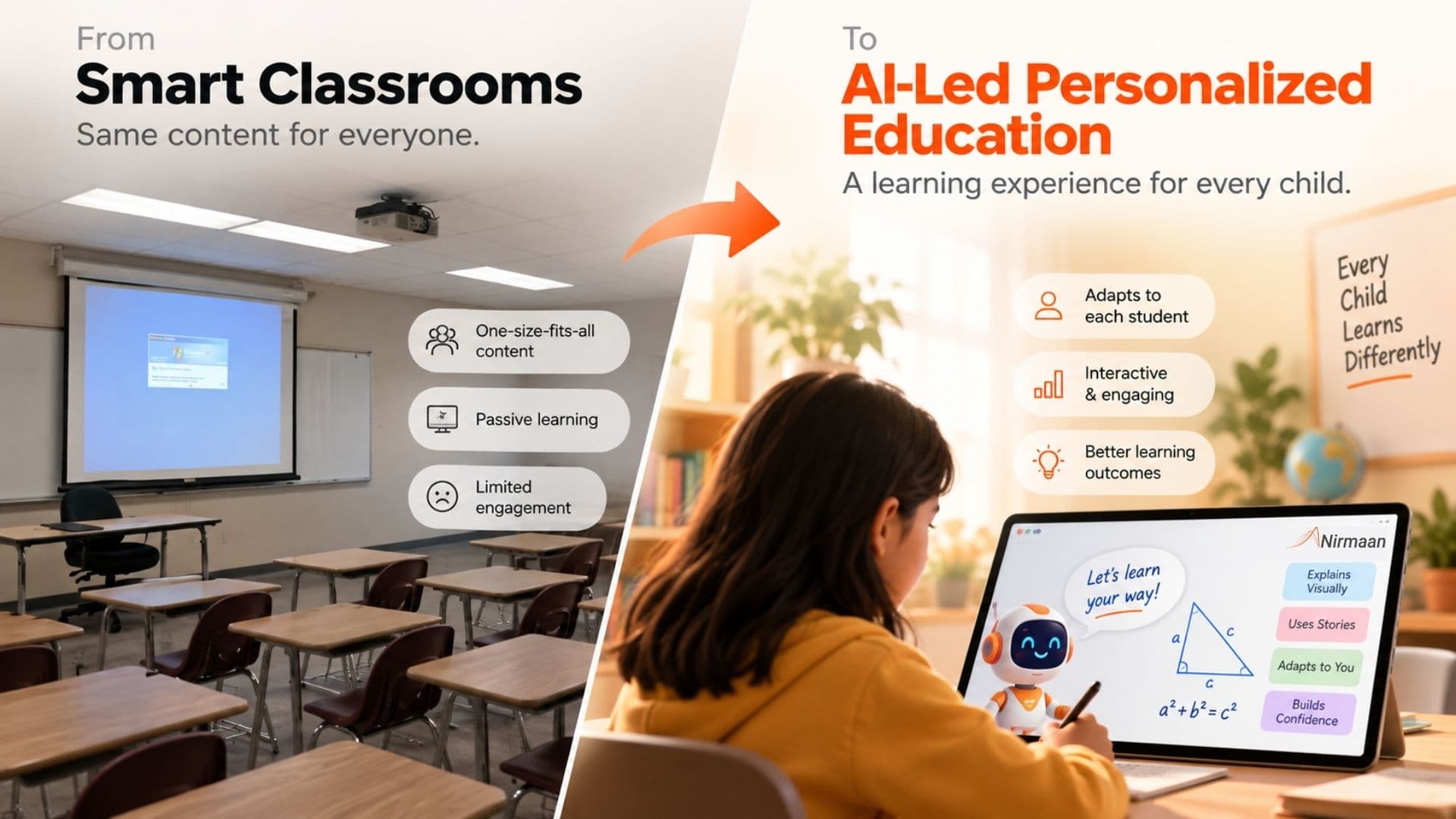
That's the pivot. From AI that answers, to AI that teaches. From massive and generic, to personal and persistent. From a search engine with nice manners, to something that actually sees your child.
What You Do This Week
Audit your child's AI use. Tonight. Pull up their last five "conversations." Read them. Ask: did they learn, or did they collect?
If you can't tell, assume the second. Then institute one rule: no AI until they've written their own wrong answer first.
Struggle is the curriculum. Everything else is reference.
And demand better. From the tools. From the schools. From the industry selling you convenience dressed as progress. Your child deserves a tutor, not a typewriter with good grammar.
Your move: This weekend, have your child teach you what they "learned" from AI last week. If they can't, you know exactly what was happening.
References
ASER Centre (2024). Annual Status of Education Report 2023: Rural.
Ministry of Education, India (2023). NEP 2020 Implementation: Technology Integration in Schools.
P.S. I'm not neutral on this. The gap between "AI that answers" and "AI that teaches one specific child" is exactly what we're chasing at Nirmaan. Not generic help. A tutor that actually knows your kid. Worth two minutes to see where we are: