You pay fifteen, twenty, thirty thousand rupees a month. Your child disappears into coaching centres six days a week. You breathe easier because the tuition bill feels like insurance.
But here's what you need to ask tonight: What exactly is your money buying?
Not peace of mind. Not actual learning. The new NEP-aligned report cards rolling out this year expose the gap between activity and mastery—and for most tuition kids, it’s ugly.
The Simple Lie India Runs On
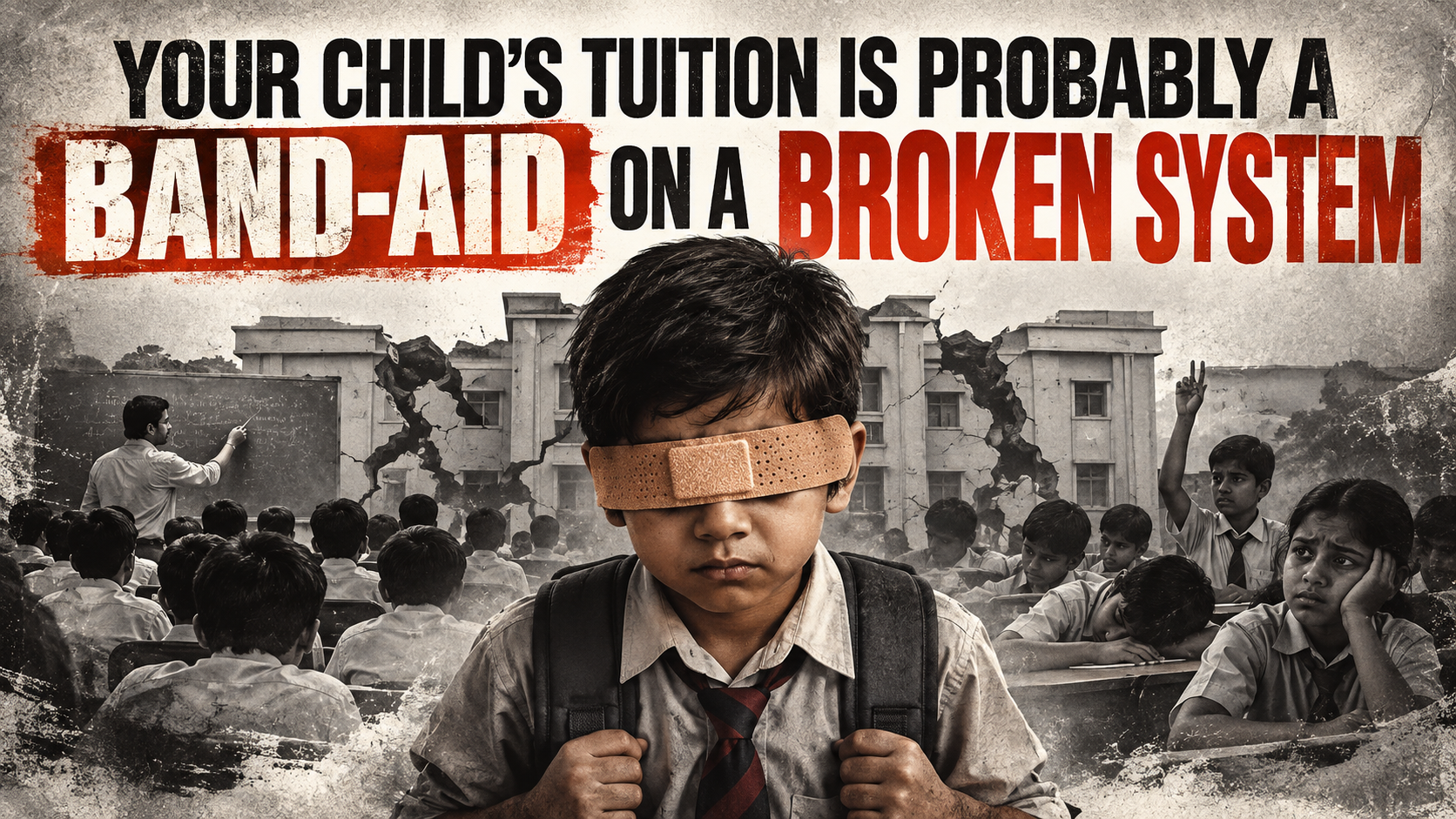
India’s education culture operates on a flawed premise: If school doesn't work, add more school.

Tuition centres replicate the exact same broken model:
One teacher
Forty kids
Same textbooks, same pace, same exam drills
The only difference? You're paying twice for the same failure.
The Foundational Crisis:
According to foundational learning metrics cited across ASER Centre Reports and national assessments, over 50% of Grade 5 students struggle with basic reading and arithmetic. These kids aren't missing hours—they're missing understanding. Tuition simply piles on hours without building foundational clarity.
The NEP report card framework finally tracks what matters: Competency, not completion. Did your child actually master fractions, or just sit through a chapter? The first data from pilot states is damning: students in traditional tuition show minor gains on memorization, but flatlines on application. They can recite; they can't solve.
The NEP Report Cards Expose Three Brutal Truths
When you measure learning instead of just labeling it, the reality shifts dramatically:
Report Card Reality Check
Traditional Report Card
Metric: Grade: A in Mathematics
The Reality: Can perform procedural sums, but cannot apply concept to real problems.
NEP Report Card
Metric: "Completed" all chapters
The Reality: Demonstrates actual mastery on only 40% of grade-level competencies.
Class Standings
Metric: Rank 12 in a class of 40
The Reality: Still 2.5 grade levels behind in reading comprehension.
Tuition centres optimize for the old system. They drill past papers, boost short-term marks, and call it success. The new report cards reveal the truth: marks went up, but mastery flatlined.
Your child isn't behind because they need more hours; they're behind because no one diagnosed where they actually stalled.
Why "Personalized" Tuition Is Usually Nothing Personal at All

"We give personal attention." Every tuition centre says this, but very few actually deliver it.
Follow the math that matters:
3 Batches X 40 Students = 120 Students per Teacher
Even if a teacher cares deeply, 120 kids per evening leaves roughly 15 minutes of actual facetime per child per week. The rest is worksheets, peer marking, and hope.
Feature / Dimension | Old Model | Ideal Model |
Diagnostic Clarity | Vague: "Weak in Math" | Specific: "Place value confusion in 3-digit numbers & denominator fraction errors" |
Solution Strategy | More worksheets | Targeted diagnostic intervention |
Real personalization requires knowing specifically where a child stumbles. It requires data, conversation, and time—three things the traditional tuition model is structurally built to avoid.
Are You Tracking the Right Number?
Parents obsess over rank, percentiles, and seat counts. The Ministry of Education's NEP Framework gives you something better: competency levels against clear benchmarks.
A Grade 4 child should handle multi-step word problems, not just drill arithmetic. They should read silently and infer, not just decode aloud. The new report cards state plainly: Meets grade-level expectations, Approaching, or Needs intervention. No vague "good effort." No A-minus that hides a year of struggle.
If your tuition centre can't show you exactly which competencies your child has mastered and where the gaps lie, they aren't personalizing anything—they're processing.
What to Ask This Week

Ask your tuition centre:
"Can you show me my child's competency report for the last three months, item by item?"
If they hand you a simple test score sheet, you have your answer. If they can't produce granular data on what's actually understood versus what's been covered, you're buying theatre, not tutoring.
📋 Weekend Action Item for Parents:
Pull your child's last tuition test.
Circle three questions they got wrong.
Ask the teacher: "What specific skill gap caused each error?"
If you get vague answers ("careless mistake," "needs more practice"), you know exactly what you're paying for.
References & Frameworks
ASER Centre / Pratham Foundation — National Status of Education Reports on Foundational Literacy and Numeracy.
Ministry of Education (NEP 2020) — Competency-Based Assessment Reforms & National Curriculum Framework.
CBSE Competency-Based Education Guidelines — Pilot Implementation Guidelines for Skill-Based Student Tracking.
CISCE Assessment Framework — Guidelines for Formative Digital Assessment and Diagnostic Learning.
P.S. The gap between what tuition centres promise and what a child actually masters is exactly what we are closing at Nirmaan. We are building AI tools that listen to how a child thinks out loud, spot the exact moment understanding breaks, and provide real-time, actionable insights before the test does.
Whether you are a school leader/management aiming to modernize assessment, a parent looking to end the tuition struggle, or a student looking for true personal learning—we have a solution for you.
To explore how these new report cards and competency-based models are being analyzed in real-world educational contexts, check out this detailed breakdown: ASER 2023: Beyond Basics Overview.
This video is directly relevant as it breaks down the official ASER assessment results and explains the critical gaps in foundational learning literacy across Indian students.