Somewhere around 2015, "smart class" became the phrase every Indian school trustee had to hear. Interactive whiteboards. Projectors. Content libraries shipped on hard drives. For mid-market private schools, especially those catering to ambitious parents in Tier 2 and Tier 3 cities, this hardware was supposed to signal modernization without the price tag of elite international curricula.
The bill came to roughly ₹3–8 lakh per classroom for installation, plus annual maintenance contracts (AMCs). NCERT estimated that over 60% of urban private schools in India had adopted some form of digital classroom infrastructure by 2019. Yet when ASER 2022 tested rural and urban private school students, the gap between them had narrowed only slightly. In some states, it had stalled entirely.
So what happened? And why are a growing number of mid-market schools quietly pulling back from hardware-heavy setups toward AI-driven personalization instead?
What "Smart Class" Actually Delivered
The promise was straightforward: Replace chalkboards with interactive whiteboards, preload CBSE-aligned animated content, and watch engagement climb.
On paper, the numbers looked defensible:
78% of teachers reported increased student attention in smart classrooms versus traditional setups, according to a 2018 study by the Central Institute of Educational Technology (CIET).
Attendance ticked up in many schools.
Parents, surveyed by EdTech researchers at IIM Ahmedabad in 2019, rated digital infrastructure as the second-most important factor in school selection after teacher quality.
The hardware vendors had a compelling pitch: one-time capital expenditure, predictable AMC costs, and content that updated annually. For schools charging ₹30,000–80,000 annual fees, this felt like a defensible modernization play.
The Reality Check:
The same CIET study noted that only 34% of teachers actually modified their lesson plans to leverage interactive features. Most used smart boards as expensive projection screens. The content, while animated, was rigid: A Class 7 student struggling with linear equations saw the exact same video sequence as one breezing through it.
The Numbers That Complicate the Story
Let's look at what happened to actual learning outcomes over nearly a decade of hardware investment.
Math Grade-Level Proficiency (2014–2022)
Urban Private Schools
2014: 51.3%
2022: 54.1%
Overall Growth:
+2.8 ppRural Private Schools
2014: 38.7%
2022: 41.6%
Overall Growth:
+2.9 pp
Nearly a decade of heavy hardware investment produced marginal gains.
More tellingly, a 2021 study by the Accountability Initiative at the Centre for Policy Research analyzed Delhi's large-scale smart classroom deployment. They found no statistically significant difference in test scores between schools with full digital infrastructure and matched controls after three years.
The hardware was present. The teaching hadn't transformed.
Where Did the Money Actually Go?
Follow the spending for a typical mid-market school with 30 classrooms:
₹1.5–2.5 crore (Upfront): Spent on interactive whiteboards, projectors, and local servers.
₹15–25 lakh (Annually): Spent on maintenance, content licensing, and IT support.
The Hidden Pedagogical Cost: 1–2 teaching periods weekly lost to hardware troubleshooting and "digital periods" that replaced active instruction with passive video consumption.
A 2022 survey of 200 Karnataka private schools by the Centre for Budget and Policy Studies (CBPS) found that 67% of "EdTech spending" was hardware-related, with only 12% directed toward teacher training or adaptive assessment tools.
Schools had purchased engagement theater. Students watched. Teachers clicked. But the fundamental loop of teaching, practice, feedback, and adjustment remained unchanged.
Why AI-Led Personalization Is Different
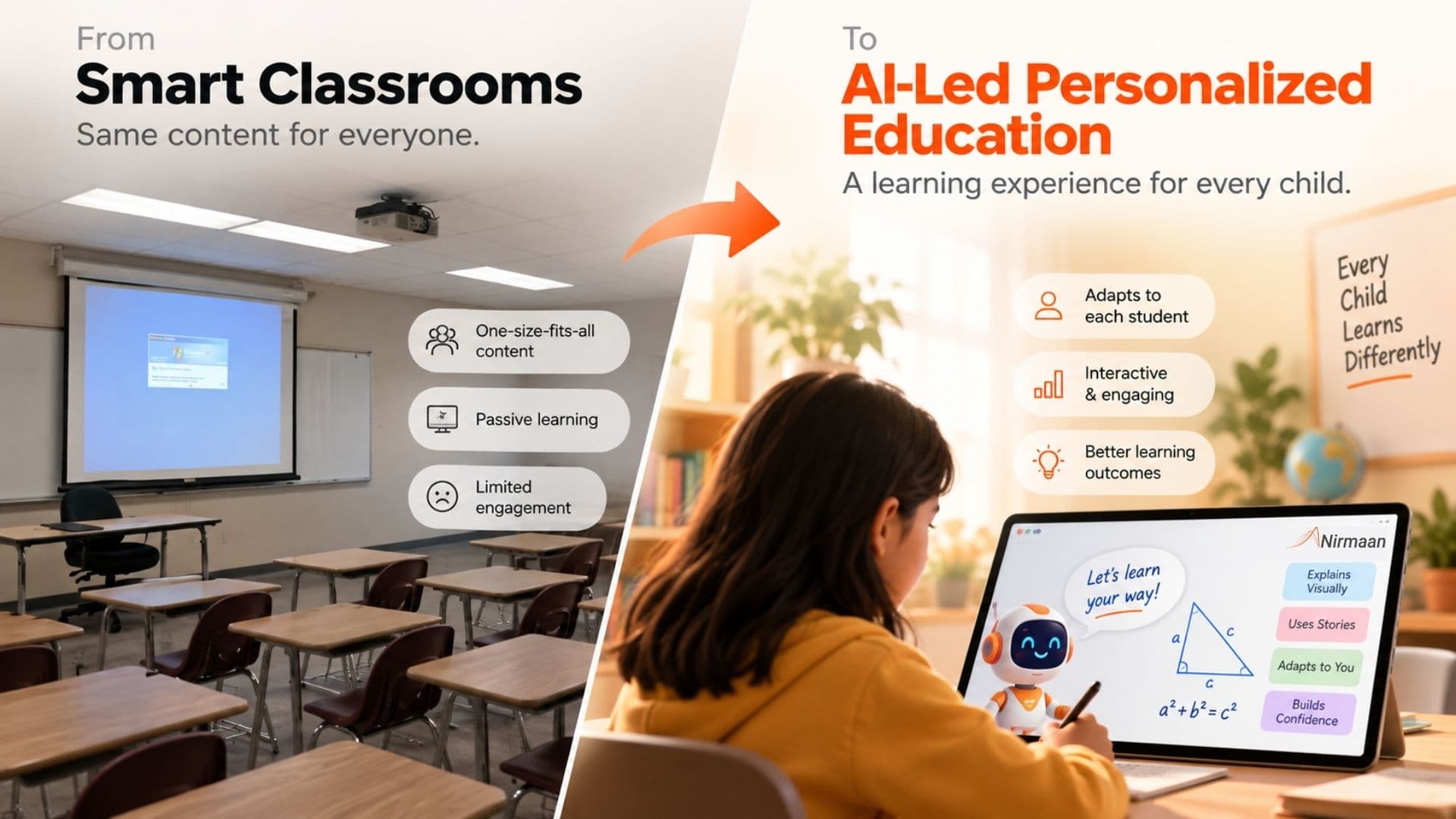
This is not a story about abandoning technology; it's about shifting from broadcast to response.
Rather than replacing the teacher with hardware, AI aims to extend what an individual teacher can perceive and respond to in a classroom of 35–40 students.
Paradigm Shift: Hardware vs. AI
Feature / Dimension | Old Model: Smart Classrooms | New Model: AI-Led Personalization |
Content Delivery | Same content sequence for all students | Adaptive diagnostic identifies individual competency gaps |
Teacher's Role | Content deliverer / Video operator | Targeted intervention allocator |
Assessment | High-stakes, term-end exams | Continuous micro-assessments embedded in daily practice |
Parent Visibility | Periodic static report cards | Real-time visibility into specific skill mastery |
Early outcome data is limited but directional. A 2023 pilot across 12 CBSE schools in Bengaluru and Hyderabad using AI-led diagnostic tools found 23% faster progression through foundational math competencies compared to control classrooms, with larger gains for students starting below grade level.
While the sample was small (1,847 students) and timeframe short, the core mechanism works: Teachers finally had visibility into which specific sub-skills each child had missed.
The Honest Objections
This shift has its skeptics, and their concerns have real weight:
Data Privacy & Algorithmic Opacity: Unlike a projector (which breaks visibly), an AI system's recommendation engine can embed biases invisible to teachers. A 2023 UNESCO Brief on AI in Indian Education warned specifically against "black-box personalization" that obscures why particular content is assigned.
Teacher Displacement & Deskilling: While vendors position AI as augmentation, a grounded concern is deskilling—teachers deferring excessively to algorithmic suggestions without developing their own diagnostic judgment.
Implementation Shortfalls: A school adopting AI tools without restructuring timetables or training teachers on data interpretation often replicates the smart-class failure mode: expensive software used as expensive decoration.
Conclusion: Technology as a Telescope, Not a Television
India's mid-market schools spent 2015–2020 purchasing visibility without utility. Classrooms looked modern, but the experience of learning did not modernize.
The pivot toward AI-led personalization is superior only if it solves the specific problem smart classrooms ignored: the mismatch between uniform instruction and variable student readiness.
For trustees and principals, the practical question isn't which technology to buy. It’s whether the school has the operational capacity to use technology as a diagnostic and intervention tool rather than a marketing signal.
According to a 2023 survey by LocalCircles, 61% of urban Indian parents believed their children's schools used "technology primarily for marketing rather than learning improvement."
The schools that can demonstrably close that perception gap will gain a genuine competitive advantage that hardware alone never provided.
References & Sources
ASER Centre (2022) — Annual Status of Education Report (Rural)
Accountability Initiative, CPR (2021) — Do Smart Classrooms Improve Learning Outcomes?
Centre for Budget and Policy Studies (2022) — EdTech Spending Patterns in Karnataka
UNESCO (2023) — Artificial Intelligence in Education: A Guidance Brief for India
LocalCircles (2023) — Indian Parents' Perception of Educational Technology
UDISE+ / Ministry of Education (2020) — Unified District Information System for Education Plus
P.S. The gap between what schools purchase and what actually reaches each child is exactly what we're trying to close at Nirmaan. We are building AI tools that map individual competency in real time—giving teachers, administrators, and parents actionable insights into where each student stands and what they need next.
Whether you are a school leader/management looking to upgrade learning outcomes, a parent seeking personalized guidance for your child, or a student aiming to master concepts at your own pace—we have a solution for you.