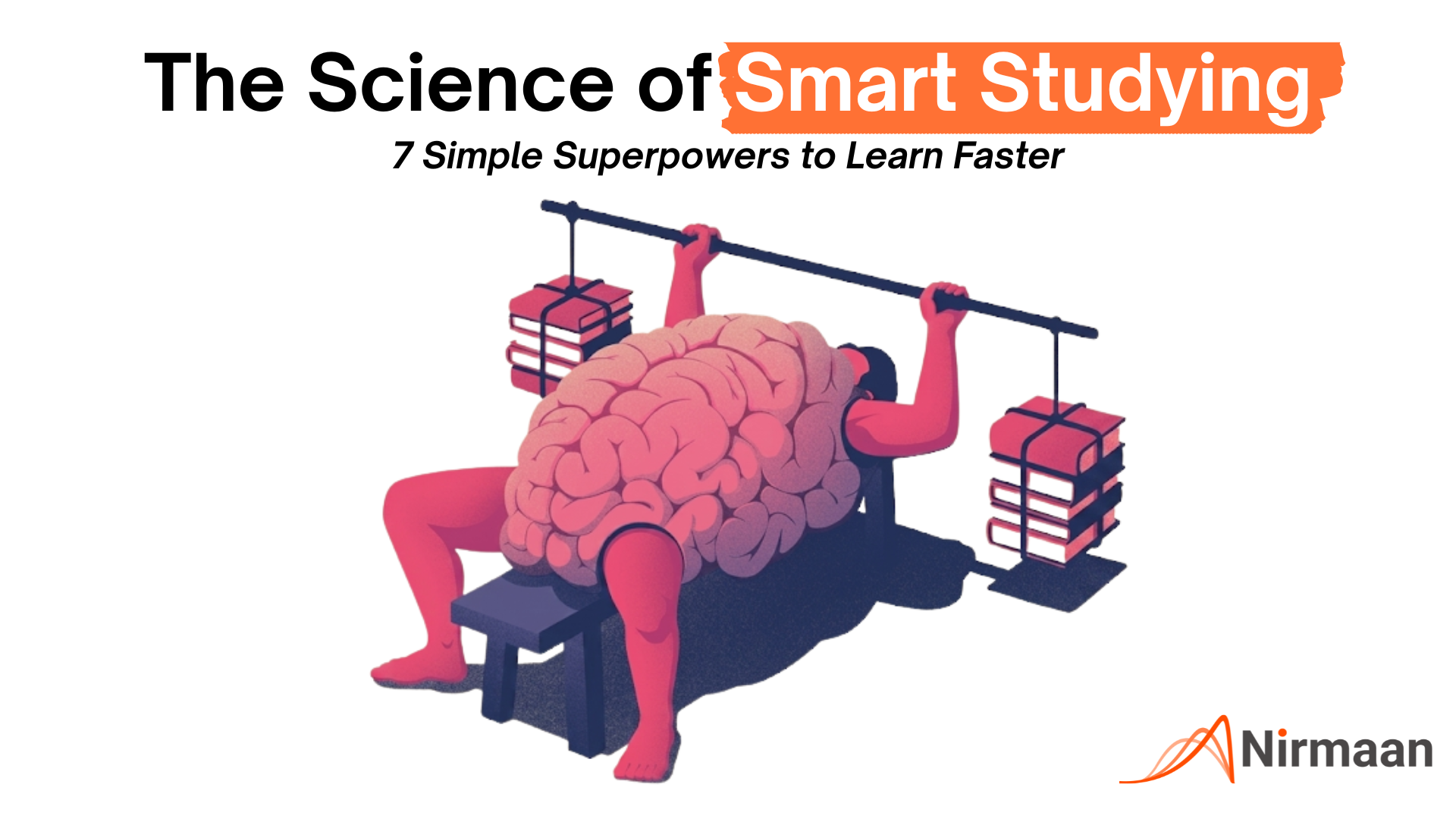
The Science of Smart Studying: 7 Simple Superpowers to Learn Faster
We have all been there: sitting at a desk late into the night, bright highlighters coloring every page, reading the same sentence over and over. You spend four whole hours, feel totally exhausted, and go to sleep thinking, "I worked so hard!"
Then test day arrives, and your mind goes blank.
Here is a big secret: it is not your fault, and you are not bad at learning. You are just using the wrong trick!
Reading a textbook over and over is like looking at a picture of a bicycle. Looking at it makes you feel like you know how to ride it. But when you get on the bike, you wobble and fall.
To make things stick in your brain forever, you have to turn your brain into a muscle that builds and lifts things. Here are seven super-simple, science-backed secrets to learn way more in half the time.
1. Active Recall: Hide and Seek with Your Brain
Imagine your brain is a giant toy box. Reading your notes is like staring into the box with the lid open. It feels easy! But Active Recall is closing the lid and trying to remember where your favorite toy is without looking.
When your brain works hard to find a memory, it builds a super-strong bridge to that idea so you never lose it again.
Old Way (Passive) | New Superpower Way (Active Recall) |
Re-reading the same page 5 times | Closing the book and writing down everything you remember |
Looking at answers while practicing | Testing yourself before looking at the answers |
Highlighting lines with pretty markers | Turning topic headlines into questions to test yourself |
How to do it:
The "Blurt" Game: Read one page of your book. Close it tight! Take a blank piece of paper and write down or draw every single thing you remember. Open the book and see what you missed.
Question Cards: On the front of a card, write a question (like "Why is the sky blue?"). On the back, write the answer. Test yourself without peeking at the back first!
2. Spaced Repetition: Defeat the Sneaky Forgetting Monster
There is a sneaky "Forgetting Monster" in our brains. Whenever you learn something new today, the monster slowly eats up to 70% of it by tomorrow!
To beat the monster, you don't need to study for 5 hours straight. You just need to give your brain a quick 2-minute high-five right before the monster eats the memory. Each high-five pushes the memory deeper into your permanent superpower bank.
Review Day | What Happens to the Memory |
Day 1 (Fresh Learn) | The memory is built, but the Forgetting Monster is waiting! |
Day 2 (High-Five 1) | You review for 2 minutes. The memory jumps back to 100%. |
Day 7 (High-Five 2) | You test yourself again. The memory stays strong for a week. |
Day 14 (High-Five 3) | The memory is now permanently saved in your brain! |
How to do it:
The High-Five Schedule: Review new ideas on Day 1, then Day 3, then Day 7, and finally Day 14.
Flashcard Apps: Use simple digital flashcard apps (like Anki) that automatically show you tricky cards right before you are about to forget them.
3. The Feynman Technique: Pretend You Are the Teacher
A famous scientist named Richard Feynman discovered a magic trick: If you cannot explain something to a 5-year-old, you don't truly understand it yet.
When we use big, confusing words, we trick ourselves into thinking we understand. But when you explain an idea using tiny, simple words, your brain quickly spots what you actually know and what is still confusing.
The 4 Simple Steps:
Step | Action | What to Do |
1 | Pick an Idea | Write the topic name at the top of a page (like "Photosynthesis"). |
2 | Teach a Toy | Explain it out loud using plain, tiny words as if teaching a teddy bear. |
3 | Fix the Bumps | Whenever you get stuck, open your book to fix that exact weak spot. |
4 | Use a Story | Make a fun analogy (like "Leaves are tiny solar panels baking green pancakes"). |
4. Interleaving: Mix Up the Game!
If you were practicing basketball, shooting from the exact same spot 100 times in a row gets easy—and boring. But in a real game, you have to run, pass, and shoot from all over the court.
Studying is the same! Doing 50 of the exact same math problems makes your brain go on autopilot. Interleaving means mixing up different types of problems in one study session so your brain stays awake and alert.
Blocked Practice (Old Way) | Interleaved Practice (Superpower Way) |
20 addition problems, then 20 subtraction problems | 5 addition, 5 subtraction, 5 multiplication, all mixed up |
3 hours straight on History | 45 mins Math, 10 min break, 45 mins History |
Brain goes on lazy autopilot | Brain stays sharp choosing which tool to use |
How to do it:
Shuffle the Deck: Instead of doing all of Chapter 1, then all of Chapter 2, mix up practice questions from Chapter 1, 2, and 3 together.
Switch Subjects: During a 2-hour study time, spend 45 minutes on Math puzzles, take a short break, and then do 45 minutes of History stories.
5. Dual Coding: Turn Words into Pictures
Your brain has two separate doors for taking in information: one door for Words and one door for Pictures.
When you only read text, you are only using one door. But when you add a picture or drawing, you open both doors at the exact same time! This doubles your brain's superpower to remember everything.
Instead of Writing... | Try Drawing... |
Long paragraphs about history events | A simple timeline map with arrows and stick figures |
Bulleted lists of science definitions | A quick doodle or diagram showing how parts connect |
Big lists of causes and effects | A fishbone map or mind map with colored branches |
How to do it:
Doodle Maps: Instead of writing long sentences, draw simple maps with arrows connecting ideas.
Little Icons: When taking notes, draw tiny symbols in the margins (a tiny lightning bolt for an important idea, or a small magnifying glass for a definition).
6. The Pomodoro Technique: Work Like a Sprinter, Not a Marathon Runner
Your brain is a muscle, not a machine. It gets tired if you force it to work endlessly without a rest.
The Pomodoro Trick splits your work into fun, short sprints. You focus deeply for just 25 minutes, and then you give your brain a mandatory 5-minute party break!
Phase | Time | What You Do |
Sprint | 25 Mins | Super Focus! Zero distractions, phone in another room. |
Rest | 5 Mins | Brain break! Stretch, get water, look out the window. |
Repeat | 4 Times | Complete 4 sprints with short rests in between. |
Recharge | 20 Mins | Take a big fun break—go outside or play a game! |
How to make it work:
Zero Distractions: For 25 minutes, put your phone in another room, close extra screen tabs, and do just ONE thing.
Real Brain Rest: During your 5-minute break, do NOT look at screens or social media! Stand up, get a glass of water, stretch, or pet your dog. Give your brain room to breathe.
7. Metacognition: Use the Traffic Light System
The smartest students aren't the ones who sit at their desk for 10 hours. They are the ones who know what they know and what needs work.
Before you start studying, do a quick "Traffic Light Check" so you don't waste time practicing things you are already great at!
Light Color | What It Means | How Much Study Time to Spend |
🟢 Green | I know this super well and can teach it easily. | 10% of your time |
🟡 Yellow | I get it, but I still make silly mistakes. | 20% of your time |
🔴 Red | I am confused and get practice questions wrong. | 70% of your time |
How to do it:
Mark Your List: Open your study list or topic list and put a colored dot next to every topic.
Start with Red: Always start your study session working on Red topics first while your brain is fresh. Stop re-reading Green topics just to feel good!
Final Thoughts: Focus Quality Beats Long Hours!
Studying smarter is all about working with your brain, not against it. Trying active recall or the Feynman technique might feel a little tough at first—and that is totally normal! That little bit of brain effort is the exact signal that your mind is growing stronger.
Pick just two techniques from this list to try today—like setting a 25-minute Pomodoro timer and using the "Blurt" method. You will be amazed at how much faster you learn and how much more time you have left to play!
References & Further Reading
If you want to explore the science behind these learning superpowers, check out these research studies and resources:
Active Recall & Testing Effect: Dunlosky, J., et al. (2013). Improving Students’ Learning With Effective Learning Techniques: Promising Directions From Cognitive and Educational Psychology. Psychological Science in the Public Interest.
The Forgetting Curve & Spaced Repetition: Ebbinghaus, H. (1885). Memory: A Contribution to Experimental Psychology. Teachers College, Columbia University.
Interleaving Effect: Rohrer, D. (2012). Interleaving Helps Students Distinguish among Similar Concepts. Educational Psychology Review.
Dual Coding Theory: Paivio, A. (1991). Dual Coding Theory: Retrospect and Current Status. Canadian Journal of Psychology.
Metacognition in Education: Flavell, J. H. (1979). Metacognition and Cognitive Monitoring: A New Area of Cognitive–Developmental Inquiry. American Psychologist.